
Why are we hiding?
On visibility, identity, and the signs we forgot to put up

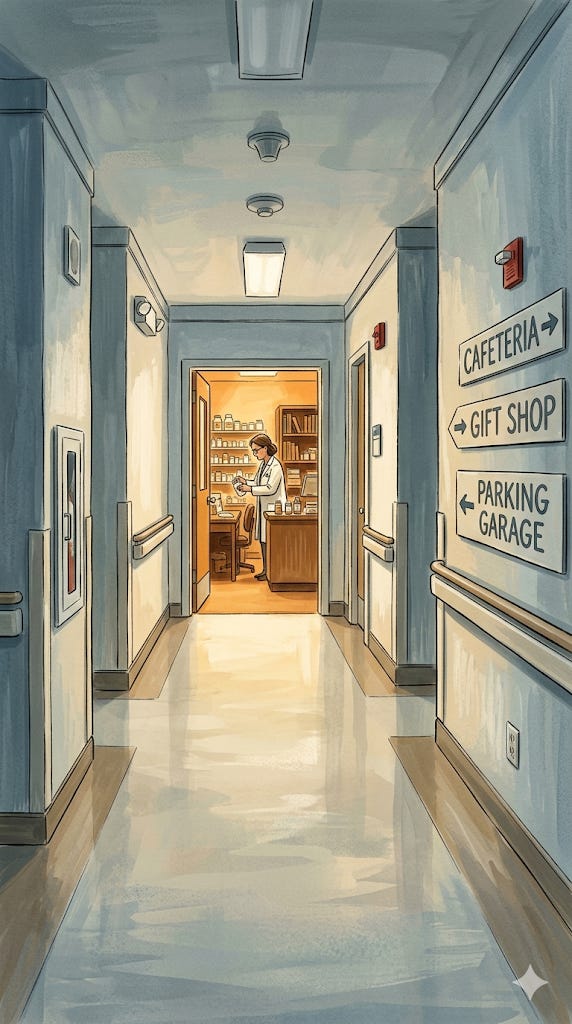
I spent thirty minutes looking for the inpatient pharmacy.
Not in a small community hospital. In one of the largest hospitals in Toronto. I asked the volunteers at the entrance, but they didn’t know. I stopped at the outpatient pharmacy right there at the front door, and they didn’t know either. No signs in the corridors. No arrows pointing the way. Nothing.
I found it eventually. But I kept thinking about those thirty minutes long after I left.
Two days earlier, I had been at a national healthcare conference. Pharmacists were everywhere: presenting, contributing, and pushing conversations forward on everything from greener inhalers to smarter prescribing to reducing medications that no longer serve their patients. The work was excellent. The thinking was sharp. The energy was real.
And yet, outside that room, I’m not sure anyone noticed. No headline. No spotlight. The kind of work that quietly shapes how care is delivered, and quietly disappears into the background the moment the session ends.
I kept asking myself on the way home: why are we hiding? Not just behind unmarked doors in hospital corridors, but more broadly, why does a profession doing this quality of work remain so consistently invisible to the institutions it serves?
I don’t have a clean answer. Just thoughts I’ve been turning over.
Is it to avoid confusing patients? Keep the inpatient pharmacy tucked away so no one wanders in looking for their prescription shampoo? Maybe. But that’s not really an answer. It’s an excuse dressed up as logistics. A hospital that can signpost its cafeteria, its parking, its gift shop—can find a way to acknowledge that somewhere in this building, pharmacists are keeping people safe.
Is it because community pharmacies are privately owned, for-profit? Perhaps that’s part of it: the assumption that commerce and clinical care can’t coexist in the same space. But family doctors’ practices are privately owned, too. For profit, too. Nobody questions their place in the clinical conversation because of their business model.
Is it something older and harder to name? Decades of being called “the druggist.” Of being framed as the dispenser rather than the clinician; of standing at the counter while the rest of the team sat at the table. Those years leave marks, not just on how others see us, but on how we see ourselves. At some point, I wonder if we started to believe the framing. Stopped putting up signs—literally and figuratively—because we’d quietly accepted that we didn’t quite belong in the clinical conversation.
Then I think about what happened after my talk at the conference.
The room didn’t just listen politely. It leaned in. Questions came fast, about how pharmacists think, about what expanded scope means in practice, about deprescribing. Someone asked out loud what I suspect many have wondered privately: if a pharmacist helps reduce unnecessary medications, does that hurt the pharmacy’s bottom line?
It’s the right question. And the fact that non-pharmacists were asking it, genuinely, curiously, without judgment, told me something important. The curiosity is there. The openness is there. What’s been missing is our willingness to be found.
We have nothing to hide from. The work is excellent. The thinking is clinical. The contribution is real.
Maybe it’s time we put up the signs.